Clefont: A Stylish Display Font for Handmade Creators
If you've ever spent hours tweaking a label, reworking an invitation layout, or second-guessing whether your sticker text will cut cleanly on your Cricut—then you know how much weight the right font carries. Clefont isn’t just another pretty typeface. It’s a thoughtful, cool, and intentionally stylish display font built for makers who need visual impact *and* real-world functionality.
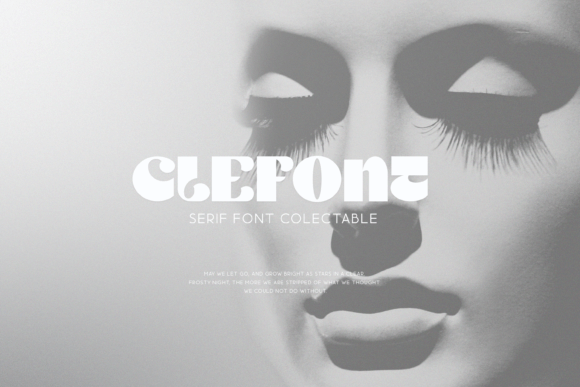
Clefont has that rare balance: bold enough to command attention, clean enough to stay legible at small sizes, and expressive enough to add personality without sacrificing professionalism. Its letterforms carry subtle rhythm and confident spacing—no awkward gaps, no cramped counters. That means when you’re laser-cutting a wooden tag or printing tiny jar labels for your small-batch honey, Clefont holds its shape beautifully. No pixelation, no fuzzy edges, no guessing whether “Est. 2023” will read clearly at 14pt on a 2" x 1" sticker.
I use Clefont across nearly every physical product I make: from boutique-style gift tags for handmade soaps to farmhouse-inspired wall signs for seasonal markets. It shines especially well on products where first impression matters—like wedding welcome boards, baby shower invitations, or limited-edition tote bags. Because Clefont is a display font by design, it’s not meant for body copy—but that’s exactly why it works so well for titles, names, monograms, and short, high-impact phrases. Think “Hand-Poured,” “Family Recipe,” “Open Daily,” or “Just Married.” Each word feels intentional, elevated, and quietly confident.
For printable creators and digital download sellers, Clefont adds instant polish to planner covers, habit trackers, and quote-based wall art. When customers preview your PDF in their browser or open it in Canva, Clefont reads as premium—not generic. That perception translates directly to perceived value. A $7 printable bundle with thoughtful typography like Clefont consistently outperforms similar designs using overused free fonts. It signals care, consistency, and brand intention—even before someone clicks “Add to Cart.”
Readability is non-negotiable when your font hits the cutting mat. Clefont was designed with clean terminals and open apertures—so letters like a, e, and s stay distinct even at 10–12pt on vinyl decals or iron-on transfers. I’ve tested it on 1.5" round stickers (yes, tiny!), and it cut flawlessly on my Silhouette Cameo 4—no overlapping paths, no lost details. For packaging, I pair Clefont with a crisp sans serif for ingredient lists or care instructions. The contrast keeps hierarchy clear while letting Clefont anchor the emotional hook.
Font pairing is where Clefont truly flexes its versatility. Try it with a relaxed handwritten font for greeting cards—Clefont as the name or occasion (“Sophie’s Birthday”), paired with a gentle script for the message inside. Or combine it with a warm, neutral serif like Playfair Display for wedding stationery: Clefont for “Mr. & Mrs.” and the serif for the rest. For modern boutique labels, I often layer Clefont over a minimalist sans (think Montserrat or Inter) —bold title above clean detail. It’s flexible, never fussy.
You’ll want to explore what’s included—especially if you're designing SVG files or layered templates. While Clefont is described as a cool and stylish display font, check whether it includes alternate characters, stylistic sets, or swashes. Even one or two elegant alternates can give your designs variation across product lines—say, using a swash capital “W” for wedding signage and the standard version for everyday shop tags. File formats matter too: make sure you have OTF or TTF for broad software compatibility (Cricut Design Space, Silhouette Studio, Affinity Designer, and Adobe apps all play nicely), and confirm multilingual support if you serve international customers or include French or Spanish phrases on bilingual product labels.
Licensing is practical, not optional. Clefont is a commercial font—meaning it’s fully cleared for use in physical products you sell (candle labels, mugs, apparel), digital downloads (printables, Canva templates), SVG bundles, client work, and social media graphics. Just double-check the license terms for things like unlimited sales volume or extended use in SaaS platforms—but for 99% of crafters and small shop owners, Clefont’s standard commercial license covers exactly what you need. No surprises, no legal gray areas—just peace of mind while you focus on creating.
Seasonal projects are where Clefont really sings. I used it last fall for rustic harvest tags (“Pumpkin Spice • Small Batch • Made with Love”) and this spring for pastel Easter egg labels with delicate floral borders. Its style adapts—never clashes—with textures, patterns, and color palettes. Whether your aesthetic leans modern-minimalist, vintage-apothecary, or boho-chic, Clefont integrates without shouting over your other design choices. It supports your voice instead of competing with it.
And yes—it works on merchandise. I’ve heat-pressed Clefont onto organic cotton tees and embroidered it onto linen napkins. Its strong strokes translate cleanly into stitch files and foil stamping dies. No thin hairlines to vanish, no fragile serifs to break apart. Just solid, scalable presence.
At its core, Clefont is more than a design asset—it’s a quiet upgrade to your entire product ecosystem. It helps your candle stand out on a crowded shelf, makes your digital planner feel worth saving to favorites, and gives your Etsy listing that extra half-second of scroll-stopping clarity. In a world where handmade buyers choose authenticity *and* polish, Clefont delivers both—without asking you to compromise on either.